
'/%3e%3cdefs%3e%3clinearGradient%20id='prefix__paint0_linear_4737_37157'%20x1='3.018'%20y1='23.6'%20x2='44.925'%20y2='24.977'%20gradientUnits='userSpaceOnUse'%3e%3cstop%20stop-color='%231CB7FF'/%3e%3cstop%20offset='.502'%20stop-color='%232FF58B'/%3e%3c/linearGradient%3e%3c/defs%3e%3c/svg%3e)


Inside Arsenal's Title-Winning Season: Exclusive book extract reveals how Mikel Arteta's man-management skills ended 22-year wait for the title
Aug 19 2026 22:48 · بواسطة Isaan Khan · 0 عدد المشاهدات


On the final day of the season, Martin Odegaard was one of the last players to make his way off the Selhurst Park turf with the Premier League trophy in his hands.
Photographers commissioned by the league had already snapped the rest of the team individually and were waiting for the captain. As Odegaard spoke to photographers about getting his picture taken, an Arsenal staff member pulled the trophy off him, telling the Norwegian that 'the boss wants it (the trophy)' before quickly carrying it over to Mikel Arteta.
Even in success, there was one man who superseded it all. The power a manager wields at a football club is complex. It's not linear. It grows over time and shows itself in differing ways. In the Premier League, the power Arteta holds at Arsenal is of a rarer kind.
By the 2025-26 season, that influence was ever-present. This had not always been the case. When he arrived in December 2019, Arteta was a novice head coach inheriting a fractured environment. Authority, at that point, was something to be earned.
Over time, he imposed it, transforming Arsenal into a club shaped in his own image. The results were there to be seen: the players all respected him and there was no stepping out of line. If they did, a place on the outer perimeter would be the consequence. You either brought into the 'non-negotiables' or faced the sidelines.
There was no room for individual ego. Arteta's focus and determination is admirable, particularly in the context of his own playing career. He only won two league titles: the French Division 1 (now Ligue 1, 2001-02) and the Scottish Premier League at Rangers (2002-03). In his 11 years in England playing for Arsenal and Everton, he won the FA Cup twice – but no league trophy.
Mikel Arteta led Arsenal to their first Premier League triumph since 2004 last season
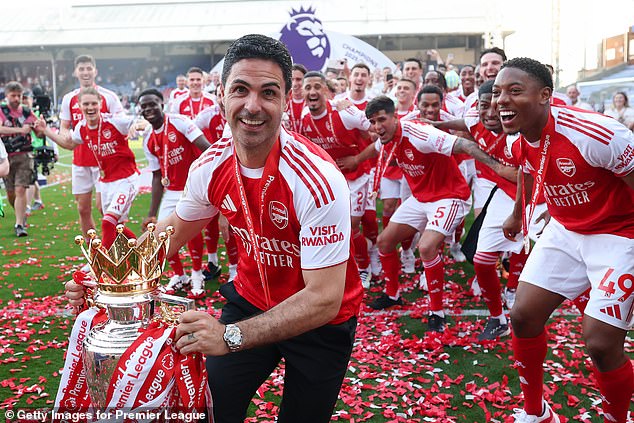
As someone who craved winning, this was short of what he desired. Going into management, he had to rebuild Arsenal before dreaming of major silverware. Finishing runners-up for three consecutive seasons had taken its toll. That's not easy to accept, nor particularly healthy given the strain on a man obsessed with the objective at hand. Yet he was still able to muster the fortitude to get to the training ground – usually at 7 am – with the belief that this season would be Arsenal's at the fourth time of asking.
Inside the training ground, Arteta's influence extended far beyond tactics. After winning the FA Cup against Chelsea in 2020, the club decided to upgrade him to 'manager' from 'head coach'. As one of just six 'managers' in the league – the other 14 are titled 'head coaches' – he held most of the keys. Departments that at many clubs operate with a degree of independence – sports science and performance analysis, for example – would report directly to the manager.
Staff presented their own work, but the feedback loop was clear. Arteta listened, questioned and then decided. What aligned with his vision stayed. What didn't was adjusted. To the outside, this looked controlling.
On the inside, in the club's view, this was a man with a clear vision, and for it to succeed, everything else had to be in sync. This was particularly significant when it came to matters such as player workload. Arteta took on board the feedback from the sports science department, for example, but had a key say on how often players train and to what intensity.
This is different to clubs with a head coach, where departments often operate independently and report upwards rather than to the coach, who is left only with the tools afforded to them. It's a luxury many bosses in football crave but rarely get the opportunity to have. For Arteta, it was expected.
When discussions emerged around the possibility of expanding the Emirates, driven by sustained demand and waiting lists exceeding 20 years, Arteta was included – not as a technical expert but as a central figure whose perspective carried weight. The stadium was part of the club's identity and therefore part of his domain.
Every process and every structure linked back to Arteta. The benefits were clear: consistency and purpose. But it also meant that any future transition would be complex. Replacing Arteta would not be a simple managerial change. It would require dismantling and rebuilding much of what had been put in place, ripping out the floorboards.
It was working. Winning softened the edges, but in moments of scrutiny his approach rarely shifted. He occasionally arrived late to press conferences to the tune of half an hour – officially because training had overrun. On one afternoon, as journalists sat down having put their recording devices on the desk in front of Arteta, he leaned toward the press officer beside him and whispered, 'What time was this supposed to start?' It was delivered quietly, but the message was clear: he would arrive on his own terms, a reminder that the media's deadlines were completely secondary to the tactical fine-tuning happening out on the pitches.
Some managers embraced these conferences as performance, while others treated them as obligation. Arteta belonged firmly to the latter camp unless he had a specific message to deliver, often doing his utmost to whip the supporters up.
Yet he was unwavering in not letting the press encroach into team matters. Before a January match, Arteta listed William Saliba as doubtful due to injury, though a source confirmed shortly after the conference that he would be available. These injury mind games would be a theme that played out across the campaign.
Arteta often used this tactic deliberately to mask the fitness of key players. It was less deception and more secrecy under the veil of controlling the narrative and protecting his players; he wanted opponents to have no idea of his starting XI until the team-sheet arrived on matchday. 'We will have to wait and see' or 'we are waiting for the training session later' were the go-to answers.
Any further pressing questions would widen his grin – but never his answers. It became a running joke among the press pack, a theatrical routine where we would probe for specifics on hamstrings and ankles, only to be met with that enigmatic, unblinking smile. He took a pleasure in the misdirection, viewing it as a vital layer of his tactical preparation.
To him, even a minor disclosure about a player's fitness was giving an opposing manager a headstart on their team shape. This obsession with information control extended across the premises, with staff tightly briefed on not allowing injury news slip out.
Details mattered, and Arteta had a meticulous eye for the minutiae. He had to fiddle with the microphone upon sitting down in press conferences. Small things – seating arrangements in press rooms, the positioning of equipment – were noticed. Nothing was too minor to escape attention.
On one occasion, a familiar journalist sitting in an unusual position prompted a moment of visible distraction. As he asked a question, Arteta injected, pointing to his right and said, 'You changed your seat.'
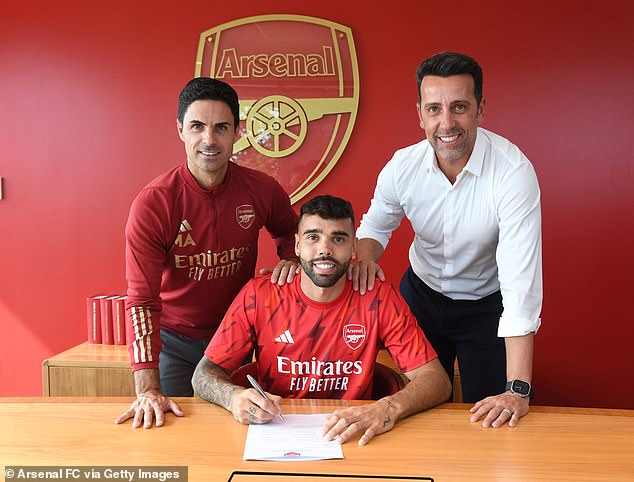
Arteta is a great man-manager, he welcomed David Raya and his family with a special touch
The environment was expected not to drift too far from his usual structure. During pre-season tours, that vigilance extended beyond the pitch. On a tour, some staff were wary of eating unhealthy food around the camp in case Arteta noticed. They did not want a stern stare or a quiet word in response. That same instinct extended to day-to-day operations.
There were also lighter touches. He is a caring man, too. In a previous season when one staff member's son was being bullied at school, Arteta invited him in to meet the players and use the gym in the evenings to build his confidence. He is conscious of lifting players.
If he senses someone needs to be picked up, he will always try to do so, whether with an arm around the shoulder or a thoughtful gesture. When David Raya was signed, he invited the Raya family to the stadium and had a custom shirt made for the goalkeeper's grandfather, Joaquin.
It is these moments which made the team want to fight to the end for him.
It is Arteta's balance between intensity and empathy which wrapped Arsenal's players and executives under his spell. For a man who seeks personal connection, those inside his inner circle are treated like family.
Arteta's control and methods were working to great effect in October. Six games, six wins. Liverpool, the league favourites among many pundits at the start of the season, were already being overtaken in the odds. Arsenal recorded 1-0 victories over Crystal Palace and Fulham. Steady displays. Three points on the board. After a testing September, the results were welcome – and needed. The consistent dropping of points is an unhealthy habit and can often prove terminal, no matter how early on in a campaign.
It was the latest evidence of how far Arteta had dragged the club. Those difficult calls and unpopular decisions had paid off, transforming Arsenal into a team capable of downing Europe's elite; a product of Arteta's long-held self-belief that rejected any glimmer of doubt, even when obstacles muddied the course. As the victories mounted across a flawless October, so too did the sense that Arsenal had become a complete reflection of their manager.
Extracted from 22 Years: The Inside Story of Arsenal's Title-Winning Season by Isaan Khan (Biteback Publishing), out August 25. To order a copy go to https://www.amazon.co.uk/dp/1837360863