
'/%3e%3cdefs%3e%3clinearGradient%20id='prefix__paint0_linear_4737_37157'%20x1='3.018'%20y1='23.6'%20x2='44.925'%20y2='24.977'%20gradientUnits='userSpaceOnUse'%3e%3cstop%20stop-color='%231CB7FF'/%3e%3cstop%20offset='.502'%20stop-color='%232FF58B'/%3e%3c/linearGradient%3e%3c/defs%3e%3c/svg%3e)


Spurs need Victor Wembanyama to play big on both ends of the floor in Game 2
Jun 05 2026 08:29 · By John Schuhmann · 25 Reads


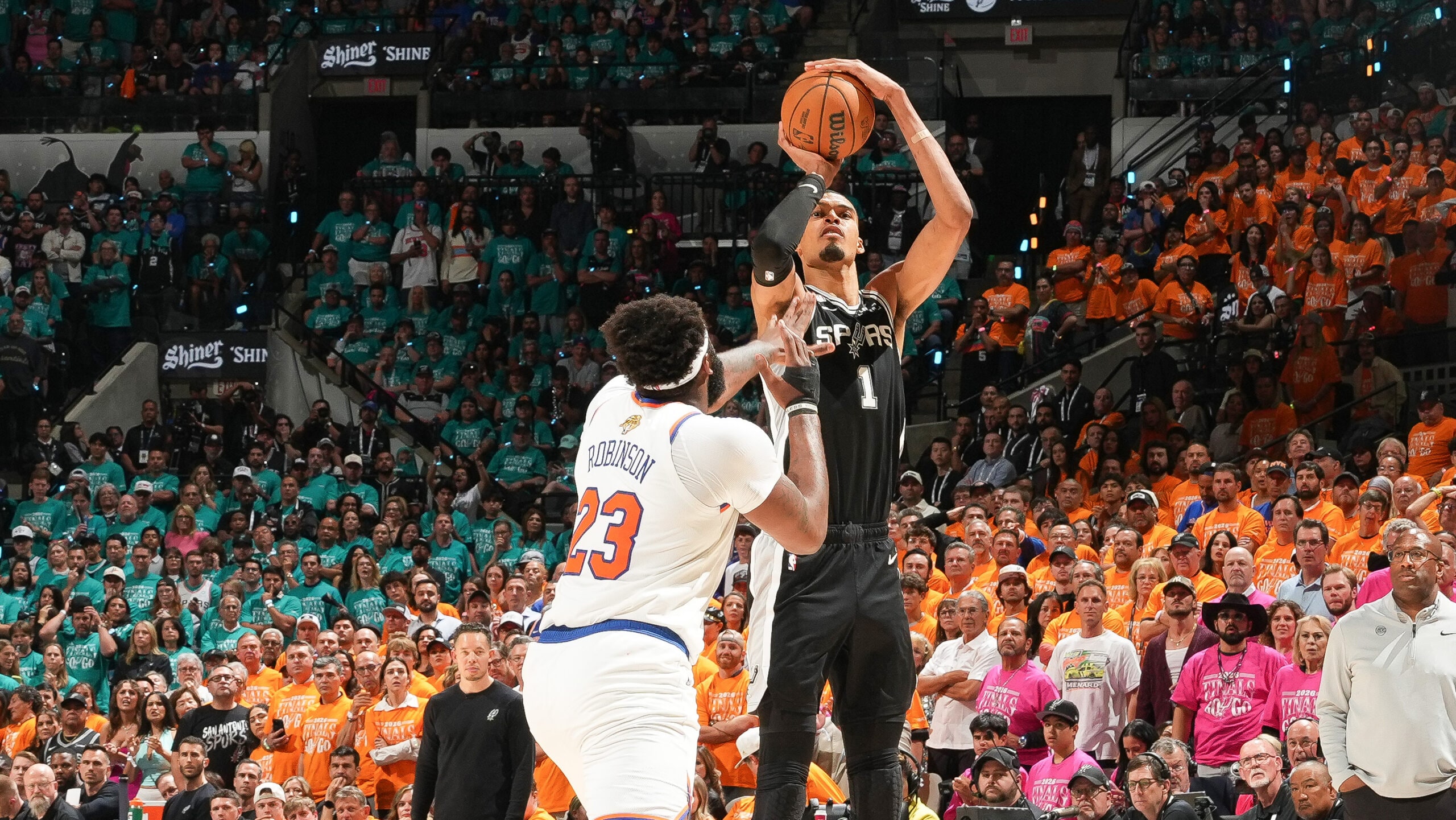
Victor Wembanyama shot just 6-for-21 (29%) in Game 1, his third worst shooting performance of the season.
•
Download the NBA App
Complete coverage: 2026 NBA Finals
SAN ANTONIO —
Both the New York Knicks and San Antonio Spurs probably think that they can play much better than they did in Game 1 of
the NBA Finals
.
The Knicks won, but it was
their worst offensive game
of the playoffs. For the Spurs, it was their third-worst offensive game of the entire season (102 games total). New York’s shot quality was relatively low, while San Antonio’s results (makes and misses).
It was an intense and exciting game, just the fifth Knicks game in these playoffs that was within five points in the last five minutes. But there’s a good chance that we won’t get anything nearly as clunky going forward.
Here are three things to watch in Game 2 on Friday (
8:30 p.m. ET, ABC
):
1. Wembanyama playing bigger
Victor Wembanyama shot just 6-for-21 (29%) in Game 1, his third-worst shooting performance (with a minimum of 15 shots) of the season. Only nine (43%) of those 21 shots came in the paint, down from 58% in the regular season. Most of those shots in the paint were well contested, and he made just four of the nine.
Getting Wembanyama easier shots near the rim is easier said than done, especially against a physical team like the Knicks that prioritizes rim protection over defending the perimeter. Pick-and-rolls aren’t going to lead to easy lobs, because weak-side defenders aren’t allowing him to go untouched as he rolls to the rim.
But they can lead to him establishing good post position as his defender recovers back …
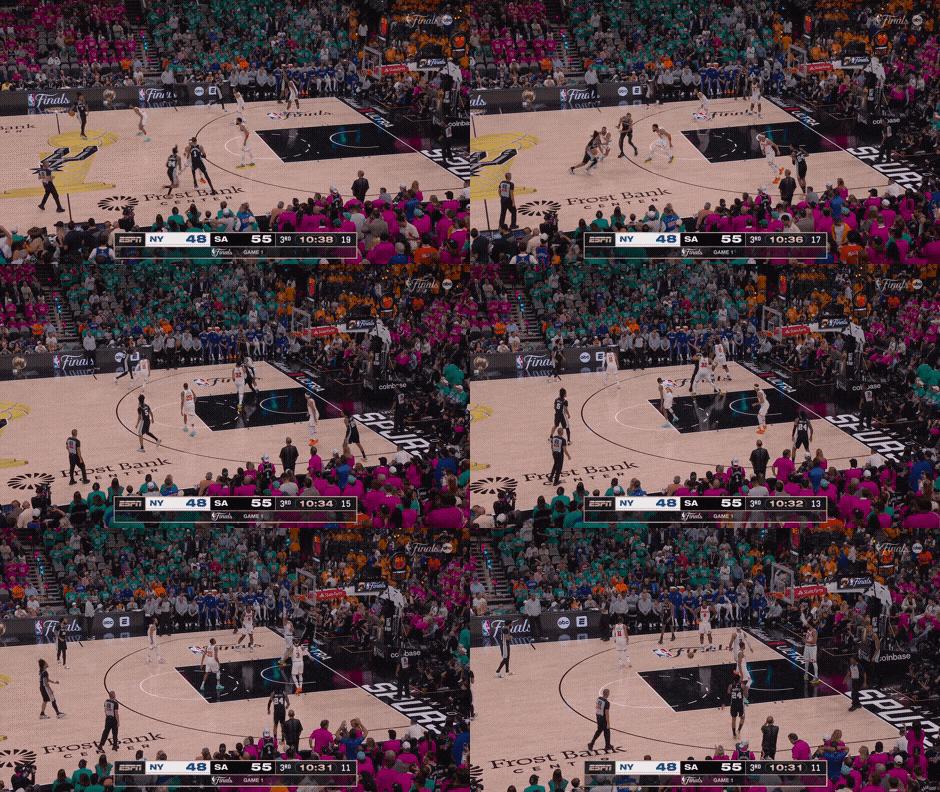
Even if he gets bumped by another defender, he can still beat his man to the restricted area, plant himself near the basket and command the ball and/or a double-team. In Game 1, we also saw him just drift away from the basket when he had similar opportunities …
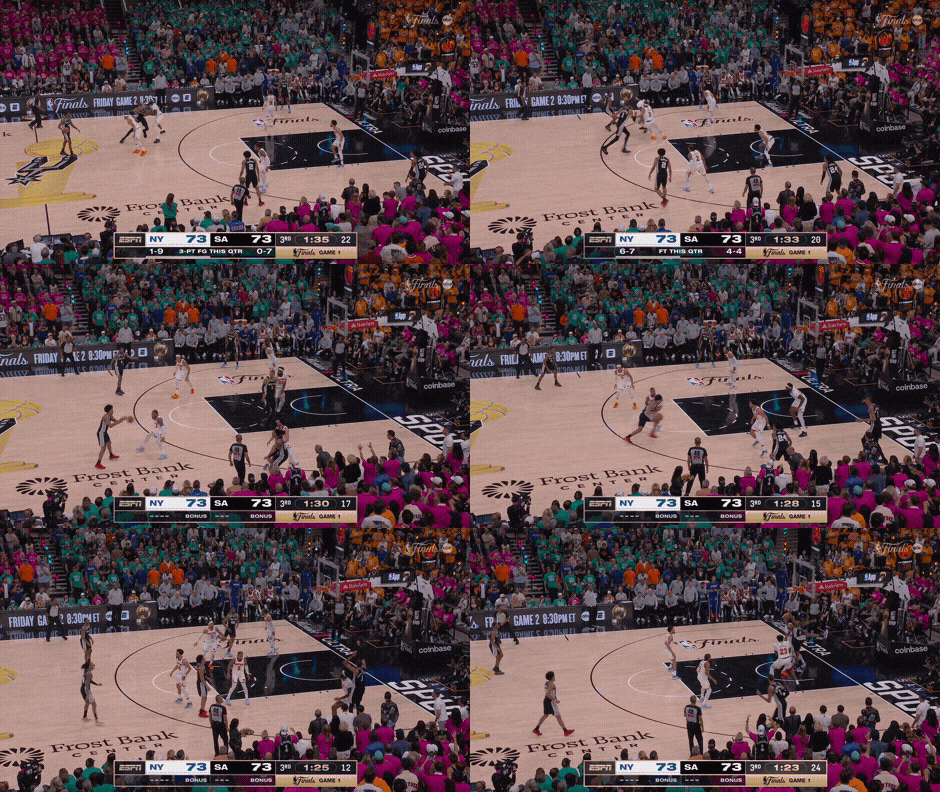
The Spurs need the 7-foot-4 guy to play big on both ends of the floor. And we should expect him to be more determined to do so in Game 2.
2. Knicks working late
The Knicks “want to play fast,” according to head coach Mike Brown. Almost always, early offense is better than late offense.
And in Game 1, there was a lot of late offense for the Knicks, who took 34 shots in the last seven seconds of the shot clock. That’s tied for the sixth-most field-goal attempts in the last seven seconds for any team in any game this season (regular season, Play-In and playoffs), and it included 12 of their 22 shots in the fourth quarter.
The Spurs took the lead when the Knicks went scoreless on six straight possessions in the fourth, with all six of those possessions ending with missed shots late in the clock. Overall, the Knicks shot 9-for-34 (26%), including 3-for-12 from 3-point range, in the last seven seconds of the clock on Wednesday.
Somehow, that was good enough. And Jalen Brunson put the game away with their final late-clock shot of the night, a ridiculous fadeaway against Devin Vassell in the final minute.
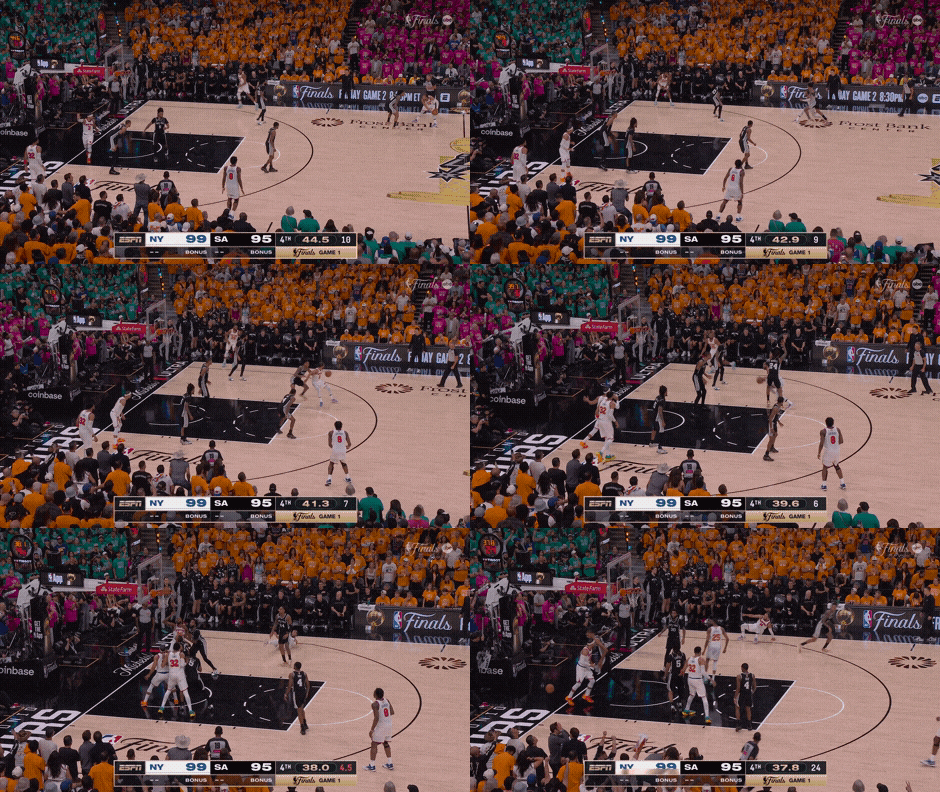
No team wants to be playing late in the clock as much as the Knicks did in Game 1. But no team is more comfortable working late than the Knicks. Among 67 players with at least 300 field-goal attempts in the last seven seconds of the shot clock over the last two seasons (regular season and playoffs), the Knicks’ five starters rank third, fifth, sixth, 10th and 12 in late-clock effective field-goal percentage.
Highest effective FG%, last 7 seconds of the shot clock, last 2 seasons
Player
FGM
FGA
FG%
3PM
3PA
3P%
eFG%
Kevin Durant
288
569
50.6%
67
154
43.5%
56.5%
Giannis Antetokounmpo
161
303
53.1%
3
25
12.0%
53.6%
OG Anunoby
231
510
45.3%
79
228
34.6%
53.0%
Naz Reid
143
332
43.1%
59
162
36.4%
52.0%
Karl-Anthony Towns
233
480
48.5%
29
85
34.1%
51.6%
Jalen Brunson
370
817
92
264
34.8%
50.9%
Payton Pritchard
293
691
42.4%
116
339
34.2%
50.8%
Kawhi Leonard
163
367
44.4%
45
133
33.8%
50.5%
Desmond Bane
180
429
42.0%
70
197
35.5%
50.1%
Mikal Bridges
224
518
43.2%
69
222
31.1%
49.9%
Evan Mobley
145
308
47.1%
17
74
23.0%
49.8%
Josh Hart
216
41.7%
245
32.2%
49.3%
Includes regular season, Play-In and playoffs
Minimum 300 FGA (67 players)
eFG% = (FGM + (0.5 * 3PM)) / FGA
On the other end of the floor, only 12 of the Spurs’ 89 shots in Game 1 came in the last seven seconds of the shot clock. If anything, they don’t want to be in such a rush to shoot.
“I think for the most part just we didn’t make the extra pass as much as we usually do,” Stephon Castle said Thursday. “We kind of settled a lot more than we usually do. I think Coach preaches a lot — try and find better each possession, try and find the best shot.”
The Knicks have now played four games against the Spurs and three of those games account for three of the seven times that the Knicks have taken at least 29 shots in the last seven seconds of the clock.
So expect more late offense in Game 2 on Friday, when the Knicks’ ability to execute in the final few seconds of the shot clock could determine whether or not they head back to New York with a 2-0 lead.
3. Switching and the glass
The Spurs had more offensive rebounds (14) than the Knicks (10) in Game 1. But while all offensive rebounds lead to second chances, all second chances don’t come from offensive rebounds. (They also come from loose-ball fouls or rebounds than go out of bounds off the defense.) And second-chance points were 23-14 in favor of the Knicks.
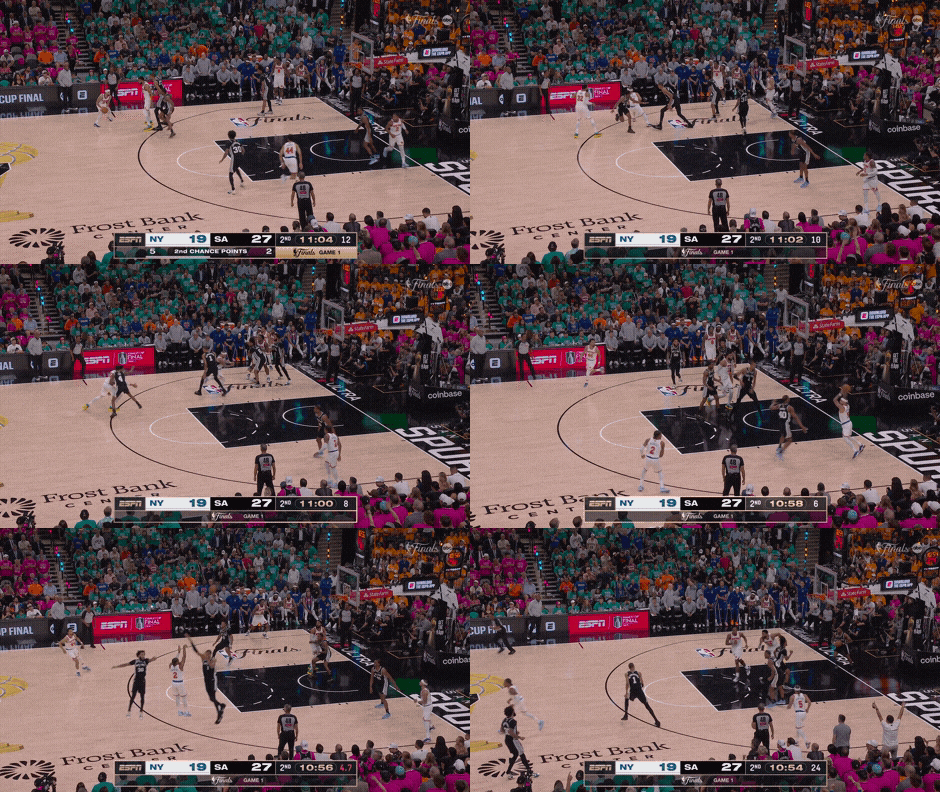
The Spurs switched ball-screens pretty liberally on Wednesday, and that often led to mismatches for Karl-Anthony Towns.
Early in the second quarter, Wembanyama switched a Towns screed for Jose Alvarado, leaving De’Aaron Fox on Towns. The Knicks’ big man took Fox into the paint and drew help, which led to a catch-and-shoot 3 for Miles McBride …
Late in the second, Wembanyama switched a Towns screen for Brunson and successfully defended the ensuing isolation (another late-clock shot). But Towns took Castle into the paint and drew a loose-ball foul, leading to two free throws …
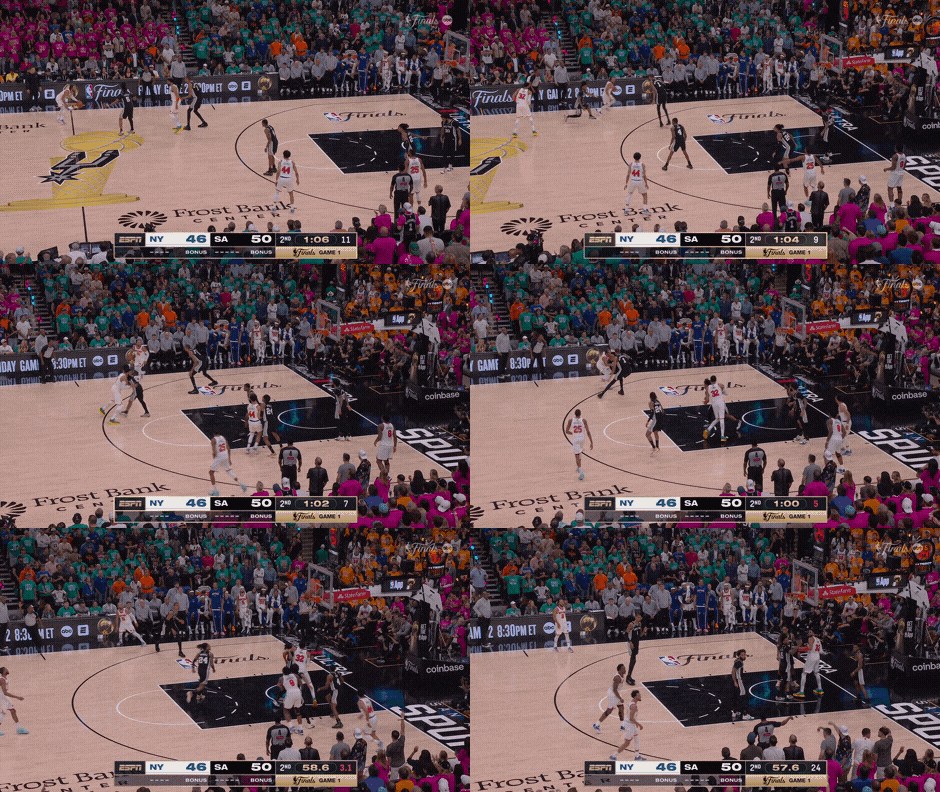
The Spurs will continue to switch, and the switching is what can often lead to those late-clock situations, because the Knicks aren’t gaining early advantages.
“We’ve switched that ball screen with me on the ball all year,” Castle said. “It’s been successful for us.”
But the advantage could come after the initial shot, and the glass will continue to be a battleground throughout this series.
* * *
John Schuhmann has covered the NBA for more than 20 years. You can e-mail him
here
, find his
archive here
and
follow him on Bluesky.